Link velocity for SEO means how quickly your website earns new backlinks over time. But there’s no magic number that tells you whether your link growth is safe or dangerous.
A new website getting 100 links in a week looks very different from an established site getting the same 100 links. The source of those links, the pages receiving them, and how naturally they were earned all matter.
So how should you judge your own link velocity? In this blog, we’ll look at what link velocity actually means, what can make a backlink spike look unnatural, and how to build links at a sustainable pace.
What Is Link Velocity and Why Does It Matter?
Link velocity is the rate at which a website gains backlinks or referring domains over a specific period. For example, if your website earns 20 new referring domains in one month, your link velocity for that period is 20 referring domains.
The important part is that link velocity isn’t a standalone Google ranking factor with a fixed safe limit. Google doesn’t publish a rule saying that getting X backlinks per month is safe while getting Y is dangerous.
What matters more is how those links were acquired and what the overall backlink pattern looks like.
For example, a company launching a useful study could naturally earn 100 backlinks in a few weeks because journalists, bloggers, and industry websites are sharing it. That spike isn’t automatically suspicious just because the number is high.
On the other hand, a site with very little content suddenly receiving hundreds of highly optimized links from unrelated websites is a very different pattern.
There is also a difference between backlinks and referring domains. One website can send you dozens of links, so looking only at the total number of backlinks can give you a distorted picture. Referring domains often give you a clearer view of how widely your site is being referenced.
One Ahrefs study found that the top-ranking pages tend to continue gaining followed backlinks from new referring domains over time, with leading pages often gaining roughly 5% to 14.5% more referring domains per month.
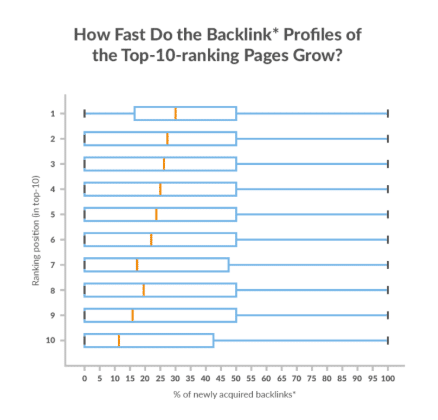
Image Source: Ahrefs
That doesn’t mean you should try to copy that percentage. It simply shows that link growth is an ongoing process rather than something that needs to happen in one giant campaign.
What Makes a Link Velocity Spike Look Unnatural?
A sudden increase in backlinks isn’t automatically a problem. The real concern is when the spike comes with other signals that suggest the links were created mainly to manipulate rankings.
The first thing to look at is where the links are coming from. If your website normally earns links from relevant industry sites and suddenly gets hundreds of links from unrelated domains, that’s worth investigating.
The same applies to anchor text. If most of your new links suddenly use exact-match commercial phrases such as “best SEO agency” or “cheap link building services,” the pattern can look much less natural than a mix of branded, URL, topical, and other naturally occurring anchors.
Another warning sign is when the links appear in large numbers without a clear reason. If a campaign produces 300 links overnight but there was no product launch, research report, viral story, news event, or other reason for people to mention the site, you should look closely at how those links were created.
Google’s spam policies specifically identify links created primarily to manipulate rankings as link spam, including certain paid links, excessive link exchanges, and optimized links placed in guest posts or other distributed content.
So don’t think of link velocity as “How many links can I safely build?”
A better question is:
“Does the way these links are appearing make sense for my website?”
How to Build Links at a Sustainable Pace
Instead of setting an arbitrary limit such as 10, 50, or 100 backlinks per month, look at your existing link profile and build from there.
If your website is new and has very few referring domains, you don’t need to force yourself into a massive campaign immediately. Start with genuinely useful opportunities: relevant guest contributions, digital PR, journalist requests, resource pages, partnerships, original research, and content that people have a reason to reference.
As your website grows, your link acquisition can naturally become more consistent.
The quality of the referring domains also matters. Ten relevant websites that genuinely chose to reference your content can be more valuable than hundreds of low-quality links generated simply to increase the backlink count.
It’s also worth tracking new referring domains, anchor text, target pages, and link quality every month. This lets you spot unusual changes before they become a bigger problem.
For example, if you normally gain 5–10 relevant referring domains each month and suddenly see 150 new domains, don’t immediately panic. First find out where they came from. If they came from legitimate coverage of something your company published, the spike has a reasonable explanation.
But if they came from hundreds of low-quality sites, identical articles, automated pages, or unrelated domains, that’s a very different situation.
Conclusion
There isn’t a magic backlink number that makes a link-building campaign safe or unsafe. Instead of trying to stay under an arbitrary monthly limit, look at; where your links come from, why those sites are linking to you, what anchor text they’re using, and whether the growth makes sense for your website.
A sudden spike can be completely natural when something genuinely earns attention. A steady stream of manipulative links can be risky even if the numbers look modest.
Build links because you have something worth linking to, not because you need to hit a certain number every month.
FAQs
1. Is there a safe number of backlinks to build per month?
No fixed number is considered universally safe. The appropriate pace depends on your website’s age, size, industry, existing backlink profile, content, and the quality of the links you’re earning.
2. Can building backlinks too quickly hurt SEO?
A fast increase in backlinks isn’t automatically harmful. The bigger concern is whether the links come from manipulative, irrelevant, or low-quality sources. A legitimate piece of content can naturally attract hundreds of links quickly.
3. Is link velocity a Google ranking factor?
Google does not publish a specific link-velocity threshold that determines whether a site ranks or gets penalized. Focus on earning links naturally and avoiding link schemes designed primarily to manipulate rankings.
4. Should a new website build backlinks slowly?
A new website doesn’t need to artificially slow down its link building. Instead, focus on building links that have a legitimate reason to exist. If a new website earns several strong, relevant links because it published something useful, the number alone isn’t the problem.
5. Should I track backlinks or referring domains?
Track both, but pay particular attention to referring domains. Multiple backlinks can come from the same website, so referring domains give you a better picture of how many separate websites are linking to you.