A few years ago, ranking on the first page was everything. It still matters, but now when you open Google, the first thing you see is an AI-generated answer pulling from multiple sources. Sometimes it links to sites ranking below the top 10. Sometimes it skips high-ranking pages completely. That creates a new challenge for every business — how do you show up there? Every business is trying hard to appear in AI Overviews.
Industry reports suggest that backlinks are one of the best and fastest ways to get featured in AI answers. In this article, we’ll find out how true that is. We’ll dig into whether backlinks actually help you show up inside AI Overviews, or if they’re just part of an outdated playbook.
What Are AI Overviews & How They Choose Sources
AI Overviews are Google’s way of answering a query directly on the search page. Instead of showing a list of blue links, Google generates a summary using information pulled from multiple websites and displays it at the top. Each answer usually includes a set of cited sources that the system considers reliable and relevant.
Recent data reveals that Google AI Overviews are becoming a staple of the search experience, with their frequency shifting based on specific queries and geography.
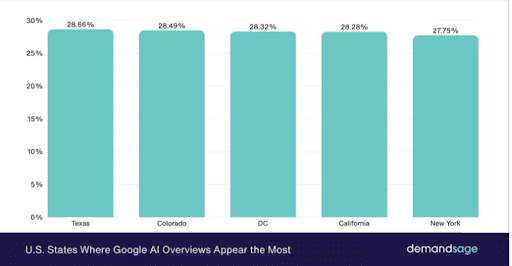
Source: DemandSage
Across the top-performing U.S. regions — including Texas, Colorado, DC, California, and New York — these AI-generated summaries appear at a remarkably consistent rate of approximately 27.75% to 28.66%.
The presence of AI Overviews becomes even more dominant when looking at search intent, particularly for informational and question-based queries. Interestingly, these overviews almost never appear in isolation; a staggering 99.2% of them show up alongside at least one other search feature.
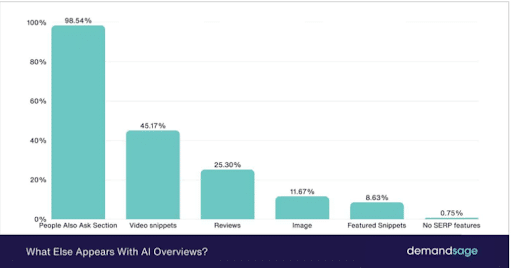
Source: DemandSage
The “People Also Ask” section is nearly universal, appearing with 98.54% of AI Overviews, followed by video snippets (45.17%), reviews (25.30%), and images (11.67%).
Now, how does Google decide which sources to include? It doesn’t pick just one page. It builds an answer by combining multiple sources, usually linking out to several sites in a single overview. These sources are selected based on three core signals:
- Relevance to the query (how well the content answers the question)
- Authority of the site (trust signals like backlinks, brand presence, and credibility)
- Coverage (how completely the topic is explained)
Do Backlinks Help You Rank in AI Overviews?
Backlinks still play a role, but not in the direct, predictable way most SEO strategies are built around.
When Google generates an AI Overview, it isn’t picking “the best-ranked page.” It’s pulling information from sources it trusts. Backlinks feed directly into that trust layer. A site with strong, relevant backlinks signals credibility, and that increases its chances of being used as a source.
According to a study, domains that appear frequently in AI Overviews tend to have strong backlink profiles. Branded web mentions have the strongest correlation with brand appearance at 0.664, followed by branded anchors (0.527) and branded search volume (0.392).
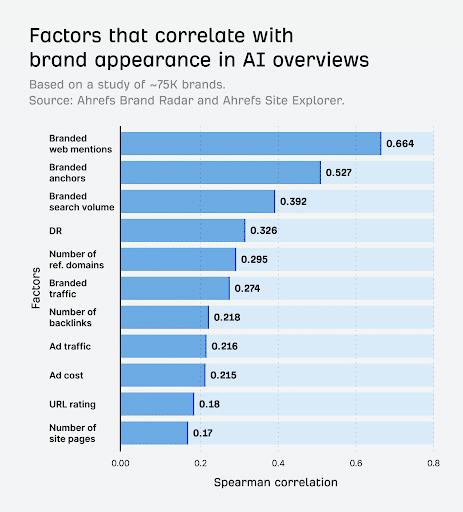
Source: Ahrefs
These are not random sites; they’ve earned links from authoritative sources and built significant brand authority.
At the same time, backlinks alone don’t guarantee inclusion. You’ll find pages with solid link profiles that never show up in AI Overviews, while some lower-ranking pages with fewer links still get cited. The difference usually comes down to how well the content answers the query. If the page explains a concept clearly, covers the topic in full, and fits the intent, it has a higher chance of being pulled into the answer.
What backlinks really do here is increase your probability. They strengthen your site’s overall authority, which makes Google more comfortable using your content as part of its generated response. Without that trust layer, even well-written content can get overlooked.
So yes, backlinks help. They act as a foundation for credibility. But to show up in AI Overviews, that authority needs to be backed by content that is clear, relevant, and built to answer real questions.
Final Verdict
Backlinks do the heavy lifting when it comes to showing up in AI Overviews. They build the authority Google relies on when choosing which sources to trust. Sites with strong, relevant backlinks consistently show up more often than those without them.
At the same time, links work best when the content is clear and useful. Backlinks put you in the race. They make your content eligible to be picked. Without them, even good content struggles to get noticed.
If you need these backlinks, reach out today. We’ll help you get featured on top media sites that help you rank in AI Overviews and Google.
FAQs
1. Do backlinks directly improve AI Overview rankings?
Yes. Backlinks build authority. Strong, relevant links help Google trust your content more, which increases the chances of it being selected as a source in AI-generated answers.
2. Are AI Overviews only showing top-ranking pages?
No. AI Overviews often include pages outside the top 10 results. Google pulls information based on relevance, clarity, and authority, not just rankings. This is why well-structured content with strong backlinks can still get featured even if it isn’t ranking first.
3. What type of backlinks work best for AI Overviews?
Contextual, high-authority backlinks from trusted and relevant sites work best. Links from niche-related content carry more weight because they strengthen topical authority, which helps Google understand your site as a reliable source for specific subjects.
4. Can a page without backlinks appear in AI Overviews?
Yes, it can, but chances are lower. Pages without backlinks rely heavily on content quality and relevance. If the answer is clear and matches the query perfectly, it can still be picked, but authority signals usually give an edge.
5. Is content or backlinks more important for AI Overviews?
Both matter. Backlinks build trust, while content determines relevance. Backlinks help your page get considered, and content decides if it gets used. The strongest results come when both authority and clear, useful information work together.