
Search has changed in a way most businesses haven’t fully caught up with yet. Because now, the real visibility comes from being included in the answers people see instantly — before they even think about clicking.
AI-driven results are pulling information from multiple sources and stitching together a single response. That means your content, your brand, and even your mentions across the web all play a role in whether you show up or get left out. It’s a mix of authority, clarity, credibility, and how well your information fits what people are actually looking for.
In this blog, you’ll see how to get featured in AI overviews and generative search results.
1. Structure Content for Answer Extraction
If your content is hard to scan, it won’t get picked. AI systems don’t “read” like humans — they extract. That means your formatting plays a huge role in whether your content is usable or ignored.
Start by breaking your content into clear, intent-driven sections. Every heading should feel like a direct response to something someone would search. Under each heading, give a clean, straight answer before going deeper. Avoid long-winded intros inside sections. Get to the point first, then expand.
But make sure to make it easy for a machine to lift your content without needing to rewrite it.
Focus on this structure:
- Use question-based or intent-based headings
- Answer the query in the first 2–3 lines
- Keep paragraphs short and focused
- Use bullet points and numbered steps where possible
- Avoid fluff and filler transitions
When your content is structured this way, it becomes “extractable.” That’s exactly what AI needs. Instead of guessing what your page is about, it can confidently pull your answer and include it in the result.
Clean structure doesn’t just improve readability. It directly increases your chances of being featured.
2. Build Topical Authority
One strong article won’t carry you anymore. AI looks for consistency across your entire site before it decides to trust you as a source.
If you only publish one or two pieces on a topic, you look like a casual contributor. But when you cover a topic from multiple angles, you start to look like a reliable source. That’s what increases your chances of being referenced.
Here’s how to approach it:
- Create a core “pillar” page on your main topic
- Build supporting articles that go deeper into subtopics
- Link all related content together naturally
- Stay focused on a niche instead of jumping between topics
- Update older content to keep it relevant
This creates a network of information instead of isolated pages. When AI systems evaluate your content, they don’t just look at one page — they look at your overall footprint.
Topical authority builds trust. And trust is what determines whether your content gets included in AI-generated answers or skipped entirely.
3. Optimize for Entities and Context
Keywords alone don’t carry the same weight anymore. AI focuses more on understanding context — who you are, what you’re talking about, and how everything connects.
This is where entities come in. Entities are recognizable things like brands, tools, concepts, and people. When your content clearly connects to these, it becomes easier for AI to understand and categorize your information.
Instead of forcing keywords, focus on clarity and relevance.
Do this consistently:
- Mention relevant tools, platforms, and industry terms naturally
- Use clear language around your services and expertise
- Build content around real concepts, not just search phrases
- Keep your messaging consistent across your site
- Avoid over-optimization and unnatural repetition
For example, if your content talks about SEO, it should naturally include related ideas like content strategy, backlinks, technical optimization, and analytics. This creates a complete picture instead of a narrow signal.
4. Add Data, Real Examples, and Unique Insights
Most content online says the same thing in slightly different ways. That’s exactly why it gets ignored. AI systems are trained to filter out generic information and prioritize content that adds something new or credible.
If your page only repeats common advice, there’s no reason for it to be selected. But when you include data, examples, or real observations, your content becomes far more valuable. And chances are you get featured on AI overviews.
Here’s what helps:
- Include statistics to support key points
- Share real examples, case scenarios, or outcomes
- Add insights from actual experience, not just summaries
- Explain why something works, not just what to do
- Update outdated numbers and references regularly
Even small additions can make a difference. A simple stat, a short example, or a clear explanation can turn a basic paragraph into something worth quoting.
AI prefers content it can rely on. Data and real insights reduce ambiguity and increase trust. When your content feels specific and backed by something concrete, it becomes easier for AI to lift it into generated answers.
5. Get Featured in High-Authority Media Sites
Your own website is only one part of the equation. AI systems also look at how your brand shows up across the web. If you’re being mentioned, cited, or linked by trusted platforms, it strengthens your overall credibility.
This is where backlinks and media placements come in. They act as validation signals. When authoritative sites reference you, it tells search systems that your content is worth paying attention to.
Focus on building visibility beyond your own domain:
- Publish guest posts on reputable industry websites
- Earn backlinks from relevant, high-quality sources
- Get quoted in articles through digital PR efforts
- Collaborate with publishers, blogs, and media platforms
- Build a natural mix of branded and contextual mentions
A study revealed that over 90% of pages get no organic traffic. And 2nd the major reason behind this is lack of backlinks.
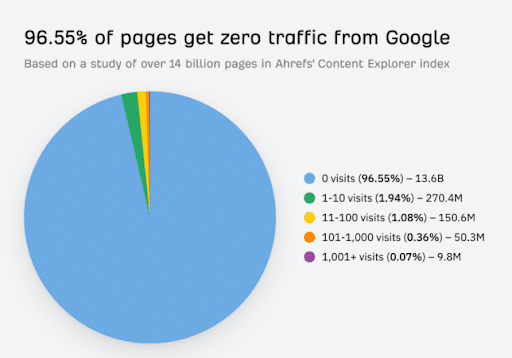
Source: Ahrefs
When your brand is consistently referenced across trusted sites, it builds authority at scale. That authority increases your chances of being included not just in rankings, but in AI-generated answers as well.
Wrapping Up
Getting featured in AI-driven results, especially if you want to get featured in AI Overviews, comes down to one thing — being worth referencing. It’s not about chasing shortcuts or relying on one tactic. You need clear content, strong topical coverage, real signals of trust, and visibility beyond your own site.
When all of these pieces work together, your chances to get featured in AI Overviews increase naturally. Focus on making your content useful, easy to understand, and backed by credibility. Over time, this builds a presence that search systems can rely on. And once that trust is there, you’re no longer just another result — you become part of the answer.
FAQs
1. What are AI Overviews and generative search results?
AI Overviews and generative search results are answers created by search engines using multiple sources. Instead of showing only links, they summarize information directly on the results page. Your content gets featured when it is clear, trusted, and directly useful for answering specific queries.
2. How can I increase my chances of getting featured?
Focus on clarity, structure, and authority. Write content that answers questions directly, organize it well, and support it with strong signals like backlinks and mentions. Consistency across your website and presence on other trusted platforms both play a key role.
3. Do backlinks still matter for AI search results?
Yes, backlinks still play an important role. They act as trust signals that show your content is credible. When high-quality websites link to you, it increases your authority, which improves your chances of being selected in both traditional rankings and AI-generated answers.
4. How important is content structure for AI visibility?
Structure is critical. AI systems prefer content that is easy to scan and extract. Clear headings, short paragraphs, and direct answers make it easier for your content to be used. Poorly structured content, even if valuable, is less likely to be picked.
5. Can new websites get featured in AI results?
Yes, but it takes effort. New websites need to build trust through consistent content, strong topical focus, and external validation like backlinks or mentions. While it may take time, clear and valuable content can still get picked if it stands out.