
When another website links to your page, the clickable words inside that link are called anchor text. Google reads those words to understand what your page is about, and it uses them as a clue when deciding where you should rank.
That sounds harmless. The problem is that anchor text is also easy to get wrong. Push your target keyword into too many links and Google can treat your whole backlink profile as spam.
In this guide, you’ll learn what anchor text is in SEO, the types you’ll find in your own backlinks, and a few simple habits that keep your profile natural, so a penalty never becomes something you have to worry about.
What Is Anchor Text in SEO?
Anchor text is the visible, clickable text in a hyperlink. It usually appears in a different color from the rest of the sentence, often blue with an underline. If a website links to your page using the words “backlink audit checklist,” those three words are the anchor text.
Search engines care about those words because they describe the page being linked to. Google’s founders explained this in their original research paper: the words in a link often describe a page better than the page describes itself. That idea has been part of the algorithm from day one.
The way websites use anchor text matters just as much as the words themselves. A natural backlink profile contains a mix of different anchor text types. As shown in the chart below, a healthy profile typically leans toward non-targeted anchor text (65%), while targeted anchor text makes up around 35%.
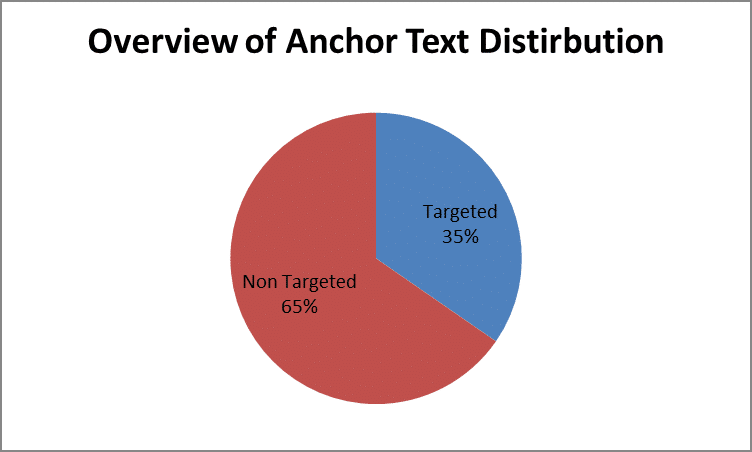
Source: Moz
This balance helps links look natural instead of overly optimized.
So when several different websites link to the same page using similar words, Google takes it as a strong hint about the page’s topic. If ten sites link to your guide using phrases about link building, Google becomes more confident that your page belongs in results about link building.
That’s the entire reason anchor text matters. It’s also the reason people started manipulating it, which we’ll get to shortly.
The Main Types of Anchor Text
Almost every anchor you’ll find in your backlinks falls into one of six types. Suppose your page sells running shoes, and your brand is called StrideFit. Here’s how each type would look.
- Exact match: the anchor is your target keyword, word for word. Example: “running shoes.”
- Partial match: the anchor includes your keyword inside a longer phrase. Example: “comfortable running shoes for beginners.”
- Branded: the anchor is your brand name. Example: “StrideFit.”
- Naked URL: the anchor is the plain web address. Example: “stridefit.com.”
- Generic: the anchor says nothing about the topic. Example: “click here” or “this guide.”
- Image anchors: when an image links to a page, Google reads the image’s alt text as the anchor.
No single type is bad on its own. Trouble starts when one type, almost always an exact match, takes over your whole backlink profile. A site that earns links naturally ends up with a messy mix of all six, and that mix is exactly what a healthy profile looks like.
How Google Reads Anchor Text (And Why It Stopped Trusting It)
In Google’s early years, anchor text carried serious weight. If you wanted to rank for a phrase, pointing enough links at your page with that phrase as the anchor could get you there. SEOs noticed, and the tactic spread fast.
It worked so well that people turned it into a joke. In the mid-2000s, pranksters got the White House biography of President George W. Bush ranking first for “miserable failure” using nothing but coordinated anchor text. Google’s results were being written by whoever built the most links.
Google’s answer arrived in April 2012 with the Penguin update, and manipulative anchor text was a primary target. According to Google’s announcement, the update affected about 3.1% of English search queries. That sounds like a small number, but it covered thousands of websites built on exact-match anchors, and many of them lost their rankings within days.
The lesson from Penguin still applies. Google wants anchor text to happen naturally, because real people linked to a useful page in their own words. Once your anchors look planned, they stop being a ranking signal and start being evidence.
What a Natural Anchor Profile Actually Looks Like
You might expect the pages at the top of Google to have plenty of keyword-rich anchors. The data says otherwise.
Ahrefs studied the backlinks of 384,614 web pages ranking in the top 20 results. The study found only a weak relationship between exact-match anchor text and higher rankings. In fact, the median top-ranking page had 0% exact-match anchor text, meaning most pages ranked at the top without a single backlink using their primary keyword as the anchor.
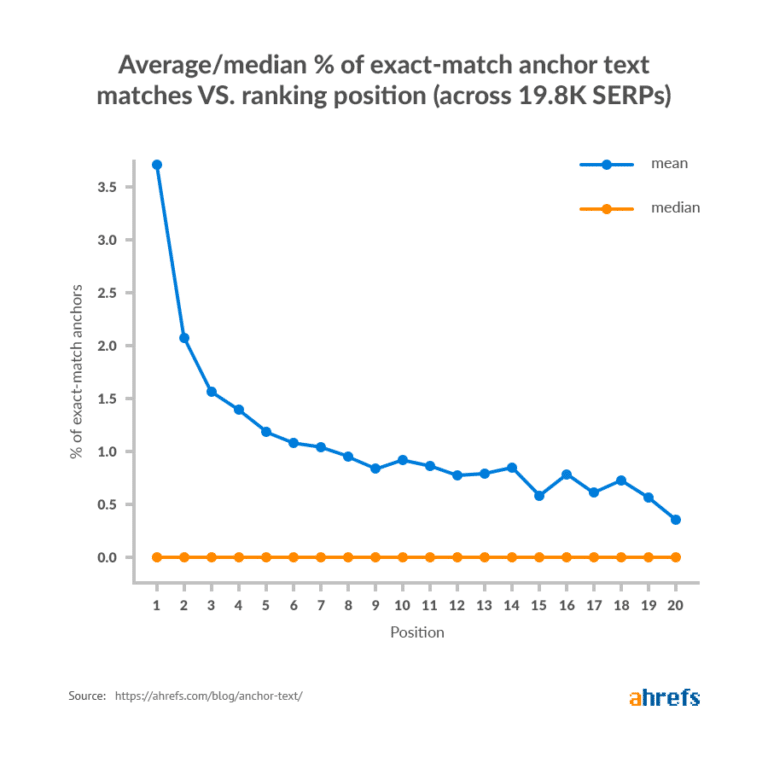
Source: Ahrefs
Even the average percentage was small, with the #1 ranking page averaging only about 3.7% exact-match anchors, and that figure dropped to around 2.1% for the #2 result and continued to decline across the remaining top 20 positions.
The same study also found, on the Ahrefs blog, a typical post gets only about 22% of its traffic from its main keyword. The rest comes from hundreds of related searches. So when you build anchors around one exact phrase, you’re chasing a small slice of your possible traffic while carrying all of the risk.
A safe profile in practice is simple to picture. Branded anchors and naked URLs make up the largest share, because that’s how people naturally mention websites. Generic and partial-match anchors fill most of the rest. Exact-match anchors exist too, but only as a small slice.
How to Use Anchor Text Without Getting Penalized
The safest approach splits into two parts, because you control internal links and you don’t control external ones.
Keep External Anchors Natural
For backlinks, your best protection is how you earn them. When links come from real publications, the writer chooses the anchor, and writers almost never pick your exact keyword. That’s one reason earned placements through HARO link building and digital PR carry so little anchor risk compared to bought links.
If you do guest posting or outreach where you can suggest the anchor, don’t reach for your money keyword every time. Branded anchors, page titles, and natural phrases age far better. The same applies to PR-driven link building methods… let the anchor fit the sentence it sits in.
And never buy packages of links with a chosen anchor. Dozens of unrelated sites using identical keyword anchors is the clearest manipulation pattern Google can find.
Be Descriptive With Internal Anchors
Internal links work by different rules. You control every one, and Google knows that, so you can be more relaxed here. Descriptive internal anchors that include the keyword help both readers and search engines understand your site.
Variety still matters, though. Linking to the same page from fifty places with one identical phrase looks mechanical. Describe the destination page naturally and let the wording change with the sentence around it.
Review Your Anchors Regularly
Anchor problems build up slowly, so check your distribution a few times a year. Pull your backlink data from Google Search Console, Ahrefs, or Semrush and open the anchors report. You’re looking for patterns, not perfection.
If one keyword shows up across an unusual number of referring domains, dig into where those links came from. A regular review of the links pointing to your site catches these issues while they’re still easy to fix.
Anchor Text Mistakes That Invite Penalties
A few patterns show up again and again in penalized backlink profiles.
The first is exact-match dominance. When 40% or 50% of your anchors use the same commercial keyword, there’s no natural explanation for it, and Google knows that.
The second is identical anchors across unrelated sites. Real websites describe your page in their own words. When a plumbing blog, a crypto site, and a recipe forum all use the same four-word anchor, someone clearly ordered those links.
The third is anchors that don’t match the destination. Linking the phrase “best project management software” to a page about kitchen renovations confuses users and signals spam.
And the fourth is stuffing the same exact keyword into every internal link, menu, footer, and sidebar. Internal links carry less risk, but they aren’t invisible.
Wrapping Up
Anchor text safety comes down to where your links come from. Sites that earn links from real publications never need to worry about ratios, because writers create natural variety on their own. The profiles that get penalized are almost always built, ordered, and controlled.
So instead of managing percentages, put that energy into earning links worth having. Keep internal anchors descriptive, keep external anchors out of your hands, and review your profile a few times a year. Do that, and anchor text in SEO becomes what it was always meant to be: a small signal working in your favor instead of a liability.
FAQs
1. What is a good anchor text ratio?
There’s no official ratio, and chasing an exact percentage misses the point. Natural profiles are usually dominated by branded anchors and naked URLs, with partial-match and generic anchors filling most of the rest. Exact-match anchors should stay a small share, and in many niches, top-ranking pages have almost none.
2. Does anchor text still affect rankings?
Yes, Google still uses anchor text to understand what a page is about. But large studies, including Ahrefs’ review of 384,614 pages, show only a weak connection between keyword anchors and rankings. Treat anchor text as context for Google, not as a lever you pull to rank higher.
3. Can internal anchor text get me penalized?
It’s much less risky than external anchor manipulation because you naturally control your own site’s links. Still, avoid pointing dozens of internal links at one page with the same exact phrase. Descriptive, varied internal anchors help users and search engines without creating spam patterns.
4. How do I check my anchor text distribution?
Use the anchors report in tools like Ahrefs or Semrush, or export your backlink data from Google Search Console. Group anchors by type and look for patterns. A single keyword appearing across many referring domains deserves a closer look, especially if those domains have nothing to do with your industry.
5. What should I do if my anchor profile looks over-optimized?
Stop building keyword-rich anchors immediately. Then work on earning branded and editorial links to rebalance the profile over time. Disavow only links that are clearly manipulative or spammy. In most cases, diluting the profile with natural links fixes the problem without any drastic action.