
Every few years, someone declares SEO dead. This time, the people saying it have charts. Traffic is down across thousands of websites, AI answers sit on top of the results, and searchers get what they need without clicking anything. So is SEO dead?
The honest answer is that one specific version of it is — the version where you publish informational content, rank it, and collect free traffic. That model is breaking. Search itself, and the value of being visible in it, is doing fine.
This article walks through what the data actually shows, who’s losing, who’s winning, and what the job of SEO looks like now.
Where the “SEO Is Dead” Claim Comes From
The claim isn’t coming from nowhere. SparkToro’s 2026 zero-click study, built on Similarweb clickstream data, found that 68% of US Google searches now end without a single click. Out of every 1,000 searches, only 276 clicks reach the open web, down from 374 just two years earlier.
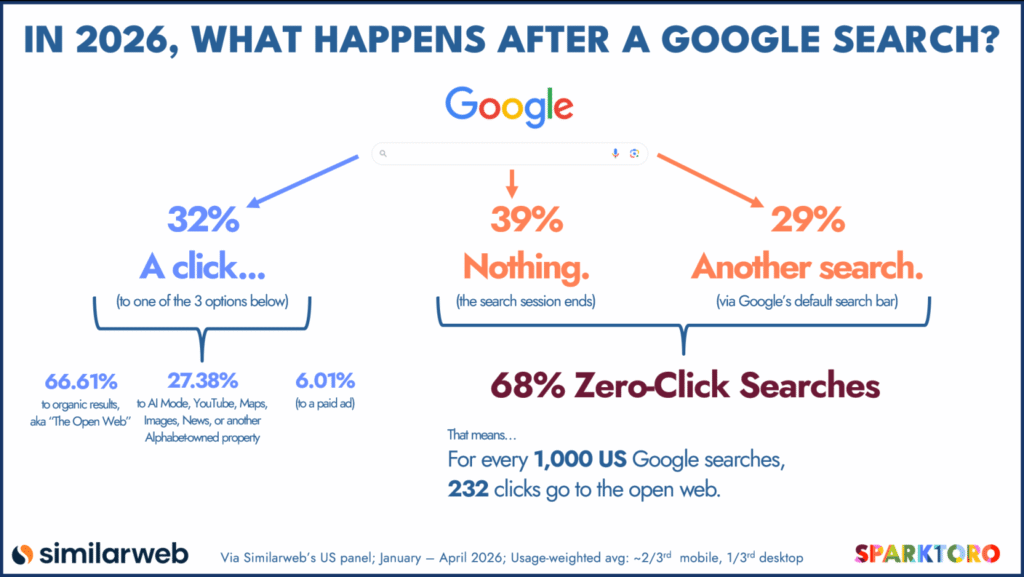
Image Source: SparkToro
That’s the fastest drop in a decade.
The biggest driver is AI Overviews, the generated answers Google places above the results. They now appear on more than a fifth of searches, and their effect on clicks is brutal. An Ahrefs analysis of 300,000 keywords found that when an AI Overview is present, the top organic result loses around 58% of its clicks.
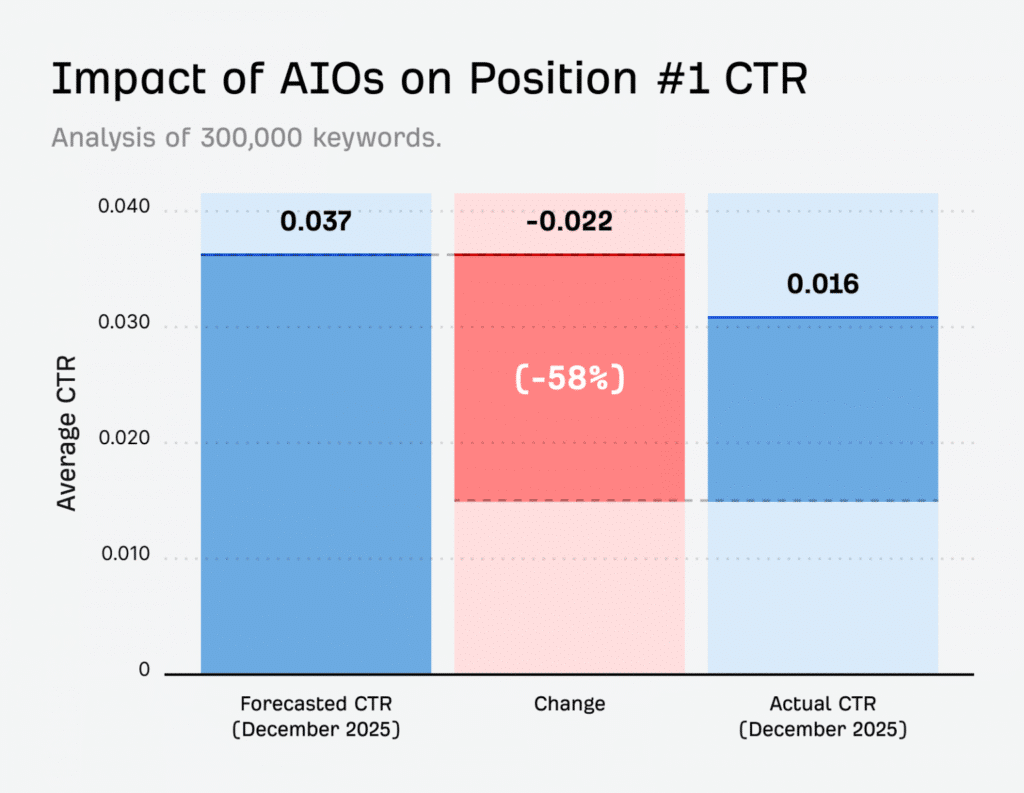
Image Source: Ahrefs
Google answers the question on the page, and the site that did the work never gets the visit.
If your entire business model was informational traffic, those two numbers explain what happened to you. Publishers, affiliate sites, and blogs built on how-to queries have lost 30%, 50%, in some cases 90% of their Google traffic. For them, the old game genuinely ended.
The Part of the Story Nobody Quotes
Now look at the other side of the same data, because it points somewhere very different.
Search volume isn’t shrinking. Google handled over 5 trillion searches and grew roughly 22% year over year. People are searching more than ever. They’re just clicking less, because the answer increasingly appears on the results page itself.
And where do those AI answers come from? From content that ranks well and from brands with strong authority signals. AI Overviews, ChatGPT, and Perplexity all lean on what’s published, what’s cited, what’s trusted. The sites being quoted inside AI answers are, for the most part, the sites that did SEO well.
So the visibility SEO builds hasn’t lost value. What’s lost value is the assumption that visibility automatically converts into a click. Those are two different things, and separating them is the key to understanding this whole debate.
Who’s Actually Dying (And Who Isn’t)
The damage isn’t evenly distributed, and that’s the strongest evidence that SEO isn’t dead so much as re-priced.
The sites getting crushed share one profile — they monetized anonymous informational traffic. Generic how-to content, dictionary-style answers, recipe roundups, thin affiliate comparisons. AI answers replace that content perfectly, because it never contained anything a model couldn’t summarize.
Meanwhile, three categories of search still send clicks and still convert. Branded searches, where people look for you specifically. Local searches, where the answer is a visit or a call. And high-intent transactional searches, where people are ready to compare, sign up, or buy. AI Overviews appear far less often on those queries, and when they do, buyers still click through to verify before spending money.
There’s a fourth winner that gets less attention… brands that get named inside AI answers. When ChatGPT or an AI Overview recommends a company, that mention carries the trust of an answer instead of an ad. The click may never come, but the customer arrives later, through a branded search, already convinced.
How Exposed Is Your Site?
Before restructuring anything, work out how much of your current traffic is actually at risk. The answer varies wildly between sites, and it decides how urgent your response needs to be.
Open Search Console and segment your top queries into three buckets: branded, transactional or local, and informational. Then check what share of your clicks comes from each. A site earning 70% of its clicks from branded and transactional queries can watch this whole debate from a distance. A site earning 80% from informational queries is standing where the flood already hit.
Next, search your top ten informational keywords and note how many trigger an AI Overview. Those queries are the ones losing clicks first, so any page depending on them needs a second purpose: earning citations, capturing emails, or building brand recall, because the click alone won’t sustain it.
Plus, ask an AI assistant the questions your customers ask before buying. If your competitors get named and you don’t, that gap is the most useful metric this audit produces, because it tells you where authority building should start.
What SEO’s Job Is Now
If the old job was “earn traffic,” the new job is “earn presence in the answer,” wherever that answer appears. In practice, that changes four things about how you work.
- Measure visibility, not just visits. A page can influence thousands of buying decisions through AI citations and on-SERP visibility while its traffic chart flatlines. Track branded search growth, AI mentions, and conversions from search, not sessions alone.
- Publish what AI can’t generate. Original data, first-hand experience, expert opinion, and real case studies survive because models have to cite them instead of replacing them. Generic explanations are the content category that died. Original insight is the one that got more valuable.
- Build the authority signals AI systems trust. Brand mentions across respected publications now correlate strongly with appearing inside AI answers. That’s why PR-driven link building has moved from a nice-to-have to the core of modern search strategy: every editorial mention is evidence AI systems weigh when deciding which brands to name.
- Capture the searches that still click. Branded, local, and transactional queries deserve more investment than ever, because they’re the traffic that remains. A conversion-focused site matters more when every click is scarcer.
What This Means for Smaller Sites
If you run a smaller site, the temptation is to conclude that the big brands have won and opt out. The data suggests the opposite move. Since AI systems reward recognizable expertise, smaller companies that build genuine authority in a narrow niche get cited alongside brands a hundred times their size. Getting quoted as an expert through HARO link building puts your name in the exact publications AI systems draw from, and doing it consistently is how small brands become “known entities” to both Google and the models.
If you’re building from zero, start with the fundamentals of link building and point every campaign at recognition, not raw traffic.
The window matters here. Very few companies have adjusted yet. Most are still chasing informational keywords with generic content, which means the brands repositioning for citations and authority right now are competing against almost nobody.
Wrapping Up
So, is SEO dead? The tactic of trading generic content for free clicks is dying, and the numbers prove it. But search grew, AI answers depend on exactly the signals SEO builds, and the searches that drive revenue still send clicks.
SEO was never actually about traffic. Traffic was the receipt. The underlying asset was always being the answer people and systems trust, and that asset just became harder to fake and more valuable to own. The companies that understand the difference will look back on this period as the moment their competitors gave up.
FAQs
1. Is SEO dead because of AI?
No, but AI ended the era of easy informational traffic. Zero-click searches hit 68% in the US, and AI Overviews cut top-result clicks by roughly 58% when they appear. SEO now earns brand visibility, AI citations, and high-intent clicks instead of raw traffic volume.
2. Should I stop publishing blog content?
Stop publishing generic content, because AI answers replace it completely. Keep publishing content with original data, first-hand experience, and expert perspective. That’s the material AI systems cite instead of summarizing, and it’s also what earns links and builds the authority everything else depends on.
3. Do backlinks still matter in AI search?
Yes, and arguably more broadly than before. Links remain a core ranking signal for Google, and the editorial coverage that produces good links also produces the brand mentions that correlate with appearing in AI answers. One campaign now feeds both systems at once.
4. What should I measure if traffic keeps falling?
Track branded search volume, conversions from organic search, appearances in AI Overviews and chatbot answers, and mentions across industry publications. Falling sessions alongside rising branded demand and stable revenue means your visibility is working, just without the click.
5. Is it still worth investing in SEO in 2026?
Yes, if you invest in the right version of it. Authority building, digital PR, original content, and conversion-focused pages compound in value as AI search grows. Buying generic content to chase informational keywords is the investment that stopped making sense.