
The guest post site looks fine. Clean design, DR 55, posts going up every week, a normal-sounding price. You pay, the link goes live, and three months later the entire domain has no traffic, no rankings, and your link sits in a graveyard.
This is happening at scale now, because AI collapsed the cost of manufacturing a convincing website to nearly nothing. The vetting shortcuts everyone used for a decade, check the DR, glance at the design, confirm recent posts, are precisely the signals a farm operator can fake in an afternoon.
This blog gives you the checks that still work… the signals that are expensive to fake, how to run them in under fifteen minutes per guest post site, and the pricing pattern that gives farms away before you inspect anything.
Why This Problem Exploded
It all started with when people started using AI tools to write content. A recent study found that roughly half of all new articles published on the web are now primarily AI-generated, a share that jumped from around 5% before ChatGPT to about 50%, where it has plateaued.
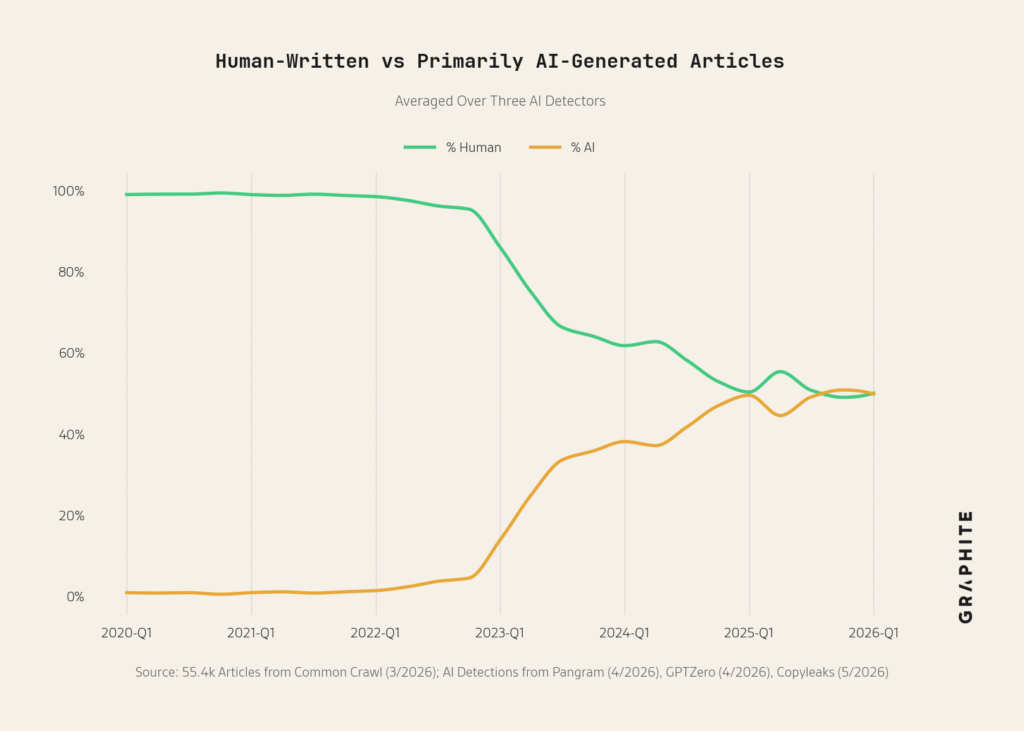
Source: Graphite
Producing a hundred plausible articles used to require writers and months. Now it requires a prompt and a weekend.
For link sellers, that rewrote the business model. Instead of maintaining a few genuine blogs, an operator spins up dozens of sites, fills each with AI articles, inflates metrics with cheap links between them, and lists everything on guest post marketplaces at attractive prices. The site only needs to look alive long enough to sell placements. When Google catches it, the operator deletes it and launches ten more.
You’re not the customer in that business. You’re the product being harvested, and the only defense is knowing which signals the operator can’t fake cheaply.
Why DR and DA Stopped Protecting You
Domain Rating and Domain Authority measure link profiles, and link profiles can be manufactured. A farm operator points expired domains and network links at a new site, and the score climbs into the 50s within months. The metric was always a proxy for trust, and proxies fail exactly when someone optimizes against them.
The signal that can’t be faked cheaply is organic traffic, because traffic requires Google’s actual trust. And Google’s trust in AI-generated sites is measurably low. A research found that 86% of articles ranking in Google Search are human-written, with AI-generated pieces holding just 14% of rankings despite making up half the supply. A site built on mass AI content almost never sustains real search traffic, which means the traffic chart exposes what the DR conceals.
So never buy on metrics alone. Open the site in Ahrefs or Semrush and look at the organic traffic graph before anything else. Flat near zero, or a mountain that collapsed after a core update, ends the conversation regardless of the score.
The 15-Minute Inspection
Traffic clears the first gate. These six checks catch the farms that still get through.
- Read three articles. Actually read them. AI-generated guest post site has a grammatically perfect paragraphs that never contain a specific number, a named example, a first-hand detail, or an opinion. If three consecutive posts could have been written about any industry by anyone, they were written by no one.
- Check the publishing math. A site publishing forty articles a month with no visible team is doing it with AI, full stop. Compare output volume against any evidence of actual staff, and be suspicious of archives where hundreds of posts appeared within a few recent months on a domain that’s supposedly years old.
- Investigate the authors. Click the author pages. Reverse-image-search the headshots, and look for the person on LinkedIn. Farms use stock photos, AI-generated faces, or the same “writer” across twenty unrelated sites. Real publications have real, findable contributors.
- Look for topical drift. A genuine niche site stays in its lane. A farm publishes whatever sells: finance next to casino reviews next to pet care next to CBD. That drift exists because the site’s editorial calendar is its order sheet, and it’s among the most reliable tells there is.
- Study the outbound links. Open recent posts and note where external links point. When every article contains exactly one or two links to commercial pages of unrelated businesses, with keyword-rich anchors, you’re reading the sales inventory. That pattern is also exactly what Google’s spam systems are trained to detect, which is why those links carry risk on top of being worthless.
- Test the human footprint. A real site has a working contact page, a specific about page, active social profiles, and comments or community somewhere. Farms have a template about page and a form nobody answers. Five minutes of looking for evidence that humans run the place usually settles it.
The Price Signal Most Buyers Ignore
Before you inspect anything for AI-generated guest post site, the price often tells you. Real sites with real audiences have editors, standards, and no desperation, which is why genuine placements cost real money or can’t be bought at all. A DR 55 site offering guest posts at $40 with 24-hour turnaround is describing its own business model to you: no editorial review, no audience worth protecting, volume as the entire game.
The lifespan data makes cheap links even worse economics than they look. Ahrefs’ research found that 66.5% of links to sites over the past nine years are dead, and churn-and-burn farm sites are the leading edge of that decay. A $40 link on a site that gets deindexed within a year costs infinitely more per month of value than a $400 placement that survives a decade, before counting the risk it attaches to your profile.
What to Do Instead
The paid guest post marketplace is now mostly inventory you don’t want, and the reliable supply of clean links moved to channels farms can’t infiltrate. Earned placements through HARO link building put you on publications with actual editors, where the vetting problem disappears because you never chose the site from a spreadsheet.
If you do continue buying placements selectively, apply the full inspection to every site, keep anchors branded, and audit the backlinks you accumulate twice a year so a seller’s quiet decline doesn’t become your profile’s problem. Assume every guest post site is a farm until it proves otherwise, because statistically, that’s now the safer prior.
Wrapping Up
Spotting an AI-generated guest post site comes down to one principle: check the signals that cost money to fake, not the ones that cost nothing. Metrics, design, and posting frequency are free to manufacture. Organic traffic, findable humans, editorial standards, and topical focus are not, and a site missing all four is a farm no matter what its DR says.
The bigger lesson is about where trust lives now. AI made surface credibility worthless by making it free, on guest post sites and everywhere else. What it couldn’t manufacture is the thing links were always supposed to represent… a real publication with a real audience choosing to reference you. Buy, earn, or build toward that, and the farms become other people’s problem.
FAQs
1. Are AI-written articles on a guest post site always a red flag?
A site using AI assistance with real editorial oversight isn’t automatically bad… a site that’s entirely AI-generated with no human standards is. The distinction shows in the details: specific data, named authors who exist, consistent topical focus, and real traffic. Judge the editorial operation, not just the drafting tool.
2. What’s the fastest single check before paying for a link?
The organic traffic graph in Ahrefs or Semrush. A genuine site shows steady or growing search traffic in the hundreds or thousands of monthly visits. A flat line near zero, or a cliff after a core update, tells you Google has already made its judgment, and no other metric overrides that.
3. Can a link from a farm site actually hurt my rankings?
A handful usually just gets ignored and wastes your budget. A pattern of them, especially with keyword-rich anchors pointing at money pages, matches the exact footprint Google’s spam systems target and can drag your profile into trouble. The realistic costs are wasted spend, dead links, and accumulated risk.
4. How much should a legitimate guest post placement cost?
Genuine sites with real audiences rarely sell placements cheaply, and the best publications don’t sell them at all. Prices vary by niche, but placements offered at $30 to $80 with instant approval are almost always farm inventory. Treat suspiciously low prices as the first red flag, not as a bargain.
5. Is guest posting still worth doing at all?
Yes, on sites that pass inspection: real traffic, real editors, real relevance to your niche. A thoughtful guest article on a genuine publication builds authority, referral traffic, and a clean link. What stopped being worth doing is bulk guest posting bought from marketplaces, which now mostly means paying farms.