
Generative Engine Optimization (GEO) gives you a new visibility question — does your brand actually show up when people ask AI platforms for information, recommendations, or solutions? Traditional SEO metrics can tell you how your website performs in Google Search, but they cannot fully show what happens inside AI-generated answers.
To measure Generative Engine Optimization properly, you need to track where your brand appears, how often AI platforms cite your content, whether those mentions bring visitors, and whether those visitors become customers.
Let’s get into practical steps for measuring your GEO results and understanding whether your strategy is working.
Track Your Brand Mentions in AI Answers
Start by finding out how often AI platforms mention your brand when users ask questions related to your industry. Create a list of questions your target customers are likely to ask and run those same questions across platforms such as ChatGPT, Google AI Mode, Gemini, Perplexity, and Claude.
Include both branded and non-branded questions. For example, if you sell project management software, you could track “What is [Brand]?” alongside questions such as “What are the best project management tools for small businesses?” Record whether your brand appears, how it is described, and which competitors appear alongside you.
Repeat these searches regularly using the same prompts. AI answers can change as models and search systems update, so one test cannot tell you much.
Measure How Often Your Content Gets Cited
Getting mentioned by an AI platform is useful, but a citation to your website gives you a stronger signal. When an AI answer links to your article, product page, research, or other content, record that citation and the page it points to.
Build a simple tracking sheet with your target question, AI platform, whether your brand appeared, whether your website was cited, and which URL received the citation. You can then calculate your citation rate by comparing the number of responses that cite your website with the total number of prompts you tested.
Pay attention to the pages that receive the most citations. If one guide earns citations repeatedly while other important pages receive none, you have a clear content signal. You can study what makes those pages useful and apply the same principles to other parts of your site.
Track Traffic From AI Platforms
Your analytics platform can show whether AI visibility is turning into actual website visits. Look for referral traffic from platforms such as ChatGPT, Perplexity, Gemini, and other AI services that send users to your website.
Track these visitors separately when your analytics setup allows it. Look at sessions, engagement, pages viewed, and other useful behavior metrics. This helps you understand what people do after discovering your website through an AI answer.
AI-driven traffic is already becoming significant for some websites. Adobe reported that traffic from generative AI sources to U.S. retail websites increased by 1,200% between July 2024 and February 2025.
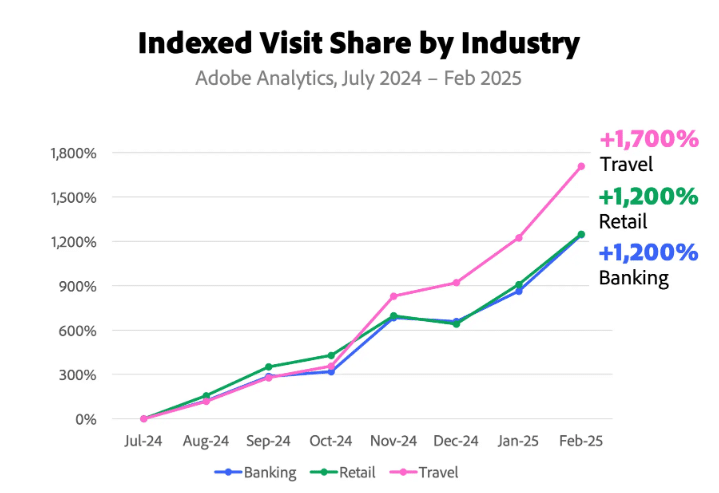
Source: Adobe
Your own numbers matter more than an industry-wide statistic, though. Compare your AI referral traffic month over month and look for consistent growth.
Measure Leads and Conversions
Traffic alone cannot tell you whether your GEO strategy is making a business impact. You need to know what happens after someone reaches your website from an AI platform.
Track actions that matter to your business, such as contact form submissions, demo requests, purchases, phone calls, newsletter signups, or booked consultations. If your analytics and CRM setup allows it, connect those conversions back to their original traffic source.
Then compare AI visitors with visitors from other channels. You might find that AI sends fewer visitors than Google Search but produces a higher percentage of qualified leads. You could also discover that certain AI platforms bring visitors who are much closer to making a purchase.
This information helps you decide where to spend your GEO efforts. If a particular type of content consistently attracts AI visitors who convert, you have a strong reason to create more content around related topics.
Compare Your GEO Performance Over Time
GEO results can fluctuate, so you should measure them consistently instead of judging your strategy from one search. Choose a fixed group of prompts and run them on a regular schedule, such as once every month.
Track your brand mentions, citations, cited pages, AI referral traffic, leads, and conversions. You can also record how often your main competitors appear in the same answers. This gives you a much clearer view of your position within generative search.
Look for movement across several metrics. If your brand appears in more answers, earns more citations, receives more AI referrals, and generates more leads, you have strong evidence that your GEO strategy is producing results.
Wrapping Up
Measuring GEO requires you to look at the complete journey from AI visibility to business results. Start by tracking brand mentions and citations, then connect those signals with AI referral traffic, leads, and conversions.
Keep your measurement process consistent and review the results over time. This will help you see which topics and pages earn visibility, which AI platforms send useful traffic, and whether your GEO strategy is contributing to actual business growth.
FAQs
1. What is the most important GEO metric to track?
Your most important metric depends on your business goal. Brand mentions and citations show AI visibility, while AI referral traffic shows whether that visibility brings people to your website. For businesses focused on growth, leads, conversions, and revenue provide the clearest picture of whether GEO is creating business value.
2. How often should you measure Generative Engine Optimization results?
Monthly tracking works well for most businesses. Use the same set of prompts, AI platforms, and measurement criteria each time so you can compare results consistently. You can run additional checks after major content updates or important changes to your SEO and GEO strategy.
3. Can you measure Generative Engine Optimization with Google Analytics?
Yes. Google Analytics can help you track referral traffic from AI platforms when those visits are correctly identified in your analytics data. You can then examine engagement, conversions, and other website behavior. Your setup may need additional source or campaign tracking to separate AI traffic accurately.
4. Should you track AI mentions even when they do not generate clicks?
Yes. A brand mention can still show that an AI platform recognizes your business as relevant to a particular topic. Track mentions alongside citations and traffic so you can see the full picture. A brand can gain visibility in AI answers even when a user never clicks through to the website.
5. How long does it take to see GEO results?
There is no fixed timeline because AI platforms update their systems and responses frequently. You should establish a baseline first and then track your target prompts consistently for several months. This gives you enough data to identify meaningful trends instead of reacting to individual AI responses.